
 My CV
My CVLastest Update: May 26, 2026
Precipitation Phase - Bridging Atmospheric Science and Hydrology
Precipitation phase – precipitation falling as rain or snow, is crucial to water resource and hazard predictions. It is one of my major focuses to study changes in the hydrological cycle. I used surface observations, remote sensing, and land surface modeling to study how precipitation phase partitioning has changed, how to improve phase predictions, and how it will affect surface hydrology.
-
Global Trends of Precipitation Partitioning
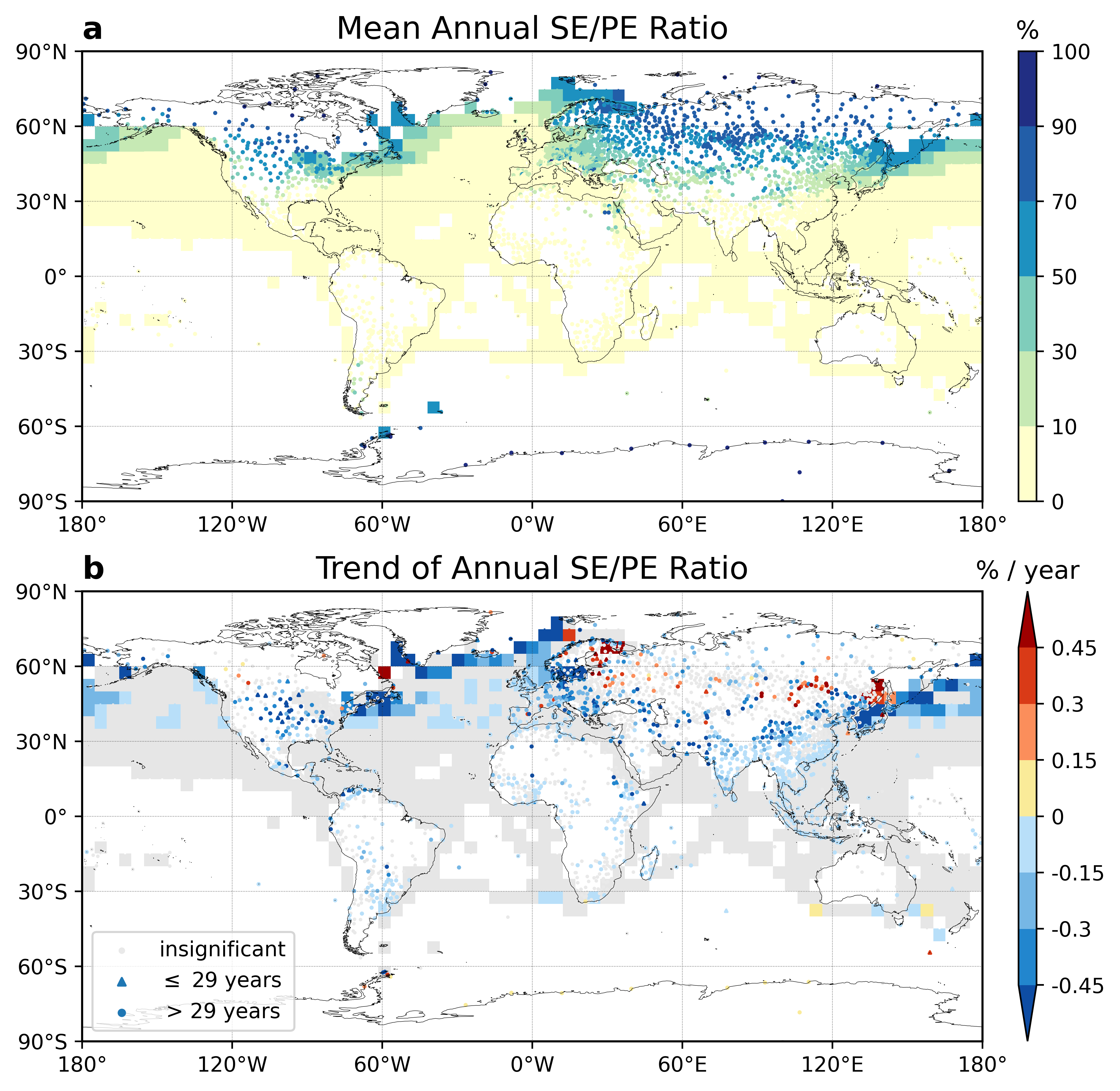
(Shi and Liu, 2021) In this study, we evaluated the global patterns of the climatology and trends in the precipitation partitioning by studying the snow event to precipitation event ratio (SE/PE ratio) based on weather stations and shipboard reports. We found an interesting latitudinal pattern in the trends of the SE/PE ratio, with large decreasing trends in the mid to low latitudes, and small decreasing or increasing trends in the higher latitudes.
-
Advanced Precipitation Phase Partitioning Method: EnergyPhase
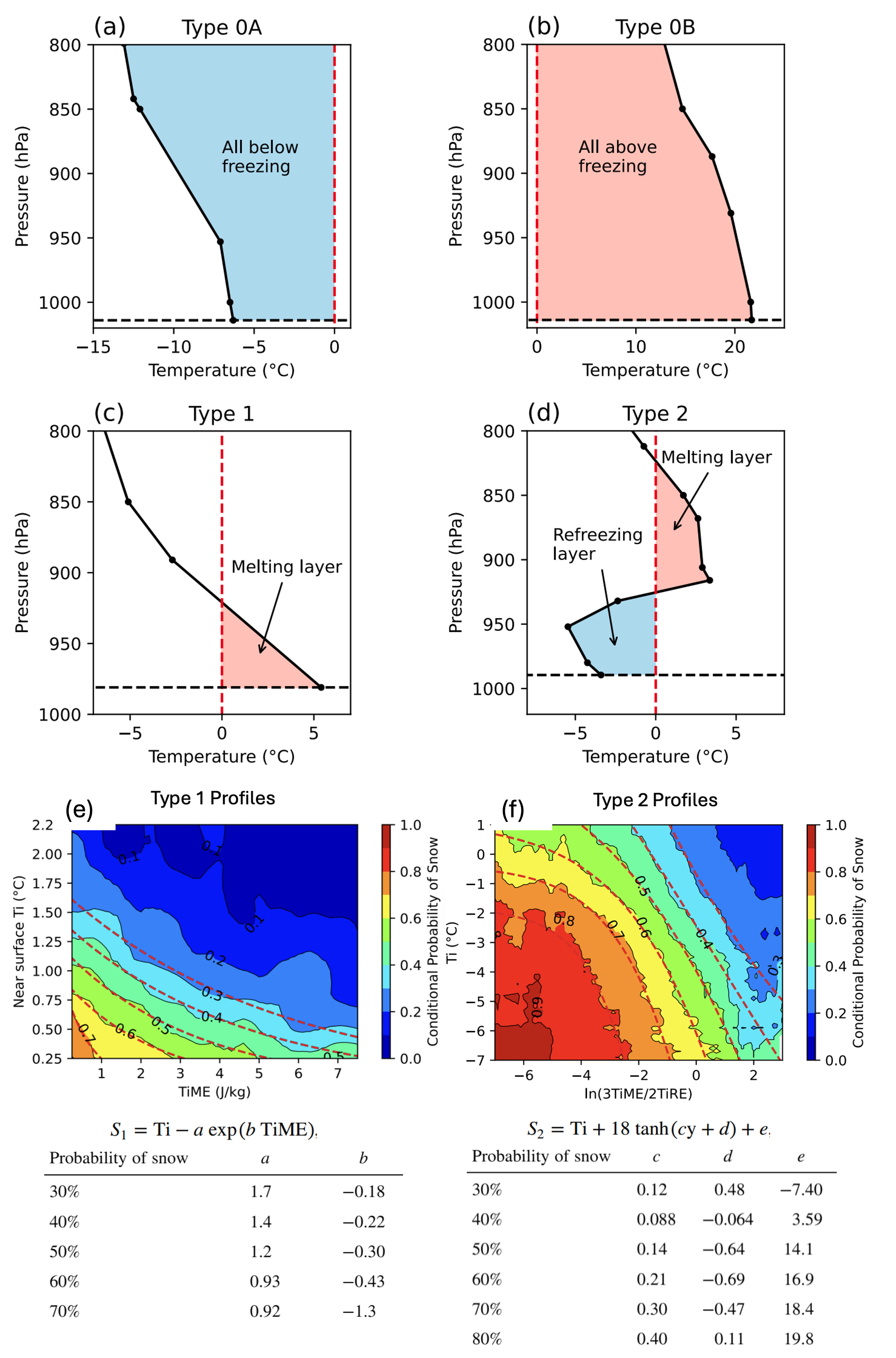
(Shi and Liu, 2024) We developed a precipitation phase partitioning method (PPM) based on atmospheric melting and refreezing energies using soundings. The EnergyPhase method greatly improves the phase classification performance for precipitation with a near-surface inversion layer. We applied this method in satellite precipitation retrievals, and we are in the process of implementing the energy method into the NoahMP land surface model.
-
Precipitation Phase Temperature Sensitivity
(Shi and Liu, 2026) Considering that the precipitation phase shift from solid to liquid will lead to reductions in snow accumulation, we aim at answering the question: how will the S/P ratio respond to 1$^{\circ}$C of warming? We conduct the analysis using CloudSat CPR and GPM DPR, and identify the regions with larger sensitivities to warming.
-
Quantitative Analysis On Snowfall Estimates
We conduct continental-scale, quantitative assessment of atmospheric profile-based PPMs (EnergyPhase) in comparison with widely-used surface-meteorology-based PPMs. We found that atmospheric profile information improves snowfall estimates, particularly in warm, moderate-to-dry months, and cold, wet months. The greatest reduction in snowfall bias is found by the look-up-table implementation of the EnergyPhase scheme. In months and locations with more Type 1 and Type 2 profiles (defined above), there would be larger bias reductions.
-
Applications in Snow Hydrology
My ongoing Fellow project studies how the precipitation phase affects snow hydrology. I am implementing EnergyPhase into Noah-MP LSM to see how different PPMs contribute to snowpack modeling biases.
Hydroclimate Variability and Extremes Across Scales
Energetic View on Precipitation Changes
At the global scale, I used an energy-based diagnostic framework to identify regimes of precipitation changes driven by radiation or circulation changes.
West African Monsoon
We are collaborating with the Applied Physics Lab to study the potential tipping points for the West African Monsoon using AI tools (TIP-GAN).
Extreme Precipitation
We explored the impact of extreme precipitation on the hydroclimate variations in the Peninsular Florida. We computed the mean, standard deviation, skewness, and kurtosis of the seasonal precipitation, and analyzed the changes in these statistical moments before and after removing extreme precipitation. We also conduct analysis for ENSO years. We conclude that extreme rain events that are critical for the overall seasonal distribution of rainfall over PF in the winter and spring, which are modulated by large-scale phenomena (e.g., ENSO), while in summer and fall, the extreme rain events are not as critical to the seasonal rainfall anomaly or the overall seasonal distribution of rainfall over PF.